Styled shelves can go wrong in two opposite directions: too empty and cautious, or so packed that nothing gets a chance to stand out. The rule of three offers a useful middle ground. It is not a rigid design law, but a simple way to organise objects so a shelf, console or bedside table feels balanced without looking overly arranged.
The idea is straightforward: group three objects that differ in height, shape, texture or function, then let the eye read them as one small composition. It works particularly well with more personal, collected interiors, where books, ceramics, framed photographs and travel finds sit together without needing to match.
What the rule of three means in interior styling
In decorating, the rule of three means arranging objects in groups of three because odd-numbered groupings often feel more natural and visually active than strict pairs. The eye moves between the objects instead of dividing the display into two equal halves.
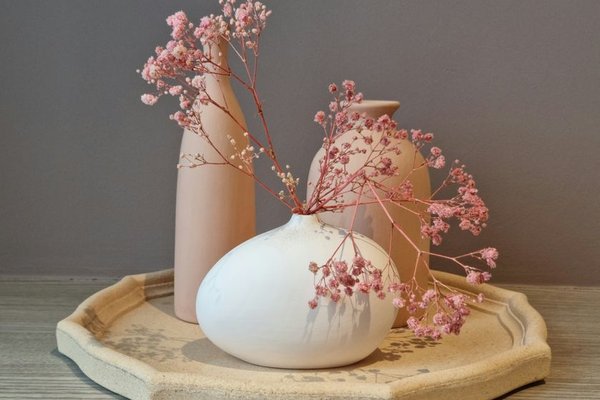
That does not mean every shelf must contain exactly three individual items. A stack of books can count as one element, a vase as the second and a small framed print as the third. The aim is to create a relationship between pieces rather than count everything literally.
Three ways to make the rule work
1. Vary the heights
Three objects at the same height can look flat. A taller piece gives the eye somewhere to start, a medium piece creates transition and a lower object finishes the group. For example, place a tall ceramic vase beside a medium framed photograph and a low stack of two books.
You do not need a perfect staircase. Slightly irregular height differences usually look more relaxed. If two pieces are similar in height, lift one on a book or small box rather than replacing it.
2. Mix shapes and textures
A successful group usually contains some contrast. Pair a round bowl with upright books and an angular frame, or combine glazed pottery with wood and paper. This is one of the easiest shelf styling tips because it prevents a display from feeling like a row of similar products.
Contrast can be subtle. A matte stone object, glossy ceramic and fabric-covered book may be enough. If the colours already vary strongly, keep the shapes calmer so the group does not become visually noisy.
3. Leave some breathing room
The rule of three decorating works best when the group has space around it. Empty space separates one visual story from the next. On a long shelf, resist filling every gap. Build one grouping, step back, then decide whether the next section needs another cluster or simply room to breathe.
This is especially useful with personal collections. Family photographs, inherited objects and souvenirs can still feel intentional if you create small pauses between groups rather than spreading everything evenly from edge to edge.
How to style a shelf without making it look staged
The easiest mistake when styling vignettes is trying to make every object coordinate. Real homes are more interesting when pieces have different ages, materials and stories. Use the rule of three to provide structure, then allow the objects themselves to be personal.
Imagine a bookcase with a small brass candlestick from a market, a framed family photograph and a handmade ceramic bowl. They do not match, but they share warm tones and different heights. Place the candlestick slightly behind the photograph, bring the bowl forward and leave open shelf beside them. The result feels considered without looking showroom-perfect.
Books are useful because they can act as both decor and risers. A horizontal stack can raise a small object, while vertical books create a taller block beside something sculptural. A naturally accumulated collection often has more character.
Use triangles rather than straight lines
A practical way to judge a three-piece arrangement is to imagine a loose triangle connecting the tops of the objects. One piece forms the highest point, while the other two sit lower at different levels. The triangle need not be symmetrical; it simply keeps the eye moving.
This approach works beyond shelves. Try it on a coffee table with a book, bowl and small vase; on a bedside table with a lamp, framed photo and dish; or on a kitchen counter with a utensil pot, chopping board and plant.
When the rule of three is not the right answer
Design rules are tools, not obligations. A single large sculpture may look stronger on a narrow shelf than three smaller objects. A pair of matching lamps can provide useful symmetry. A large book collection may be better displayed densely rather than broken into tiny decorative groups.
The rule is most helpful when a surface feels awkward and you cannot see why. Start with three pieces, adjust height and spacing, then add or remove items only if the composition genuinely needs them.
How to use it with a personal collection
The renewed preference for interiors that feel collected over time makes the rule especially useful. Instead of buying three new decorative objects as a set, start with what you already own. Choose one piece with height, one with visual weight and one smaller detail. Shared colour, material or meaning can connect them.
A travel shelf might combine a framed map, handmade pot and stack of books from places you have visited. A bedroom vignette might use a photograph, perfume bottle and jewellery dish. The grouping provides structure while the objects make it yours.
Related topics that fit naturally with this approach include shelf styling for small rooms, decorating with personal collections and mixing vintage and modern furniture.
Frequently asked questions
Does the rule of three mean I can only use three objects?
No. Three is a useful starting point, not a limit. Several small items can read as one visual element, and larger shelves may contain multiple groupings separated by open space.
Why do odd numbers often look better in decor?
Odd-numbered arrangements tend to feel less rigid than perfectly matched pairs. They create a central point plus variation around it, which can make the eye move through the display more naturally.
Can I use the rule of three with books?
Yes. Treat a stack or row of books as one element, then combine it with two contrasting pieces such as a vase and framed photograph. Books can also change the height of smaller objects.
Does the rule work in minimalist interiors?
Yes. A small three-piece grouping can add interest without creating clutter. Choose objects with clear shapes and leave generous negative space around them.
A simple rule, not a formula
The rule of three in interior styling is valuable because it gives you somewhere to begin. Vary height, mix shapes and leave breathing room, then judge the result with your own eye. If a shelf feels balanced with two objects or needs a fourth personal piece, the room does not fail the rule.
The best styled shelves look as though they have evolved rather than been assembled in one afternoon. Use groups of three to create rhythm, but let books, photographs, ceramics and collected objects tell the story. Structure makes the display easier to read; personality makes it worth looking at.